

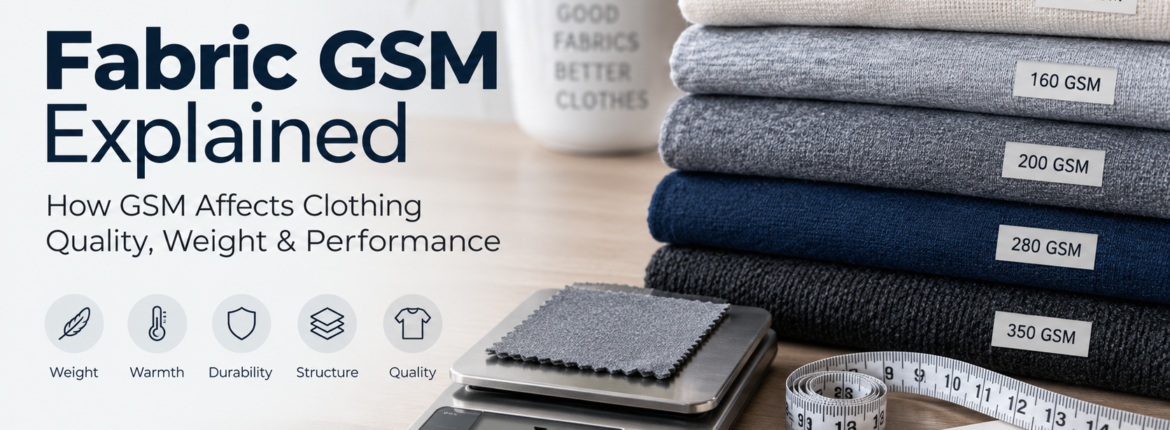
How GSM Affects Clothing Quality, Weight & Performance
Fabric GSM is one of the most important specifications to understand when selecting fabric for clothing. GSM stands for Grams per Square Meter and indicates the weight of fabric over an area of one square meter.
Whether you are developing lightweight clothing, everyday casual-wear, or heavier winter garments, understanding GSM helps you make better decisions about fabric weight, garment feel, comfort, structure, and performance.
In this guide, we explain what fabric GSM means, how it is measured, and why it matters in clothing manufacturing.
What Is GSM in Fabric?

GSM means Grams per Square Meter.
It tells you how much one square meter of fabric weighs.
For example:
- 150 GSM = 150 grams per square meter
- 200 GSM = 200 grams per square meter
- 300 GSM = 300 grams per square meter
Generally, a higher GSM indicates a heavier fabric, while a lower GSM indicates a lighter fabric.
However, GSM alone does not determine fabric quality. Fiber composition, construction, finishing, texture, and manufacturing processes also affect how a fabric performs.
Why Is Fabric GSM Important?
GSM can influence the overall characteristics of a garment, including:
- Fabric weight
- Comfort
- Warmth
- Drape
- Structure
- Opacity
- Durability
- Garment weight
- Fabric consumption
- Production cost
For clothing brands and manufacturers, having a defined GSM specification also helps maintain consistency between samples and bulk production.
Does Higher GSM Mean Better Quality?
No.
A higher GSM simply means that the fabric is heavier per square meter. It does not automatically mean the fabric is better.
The ideal GSM depends on the type of garment, season, desired appearance, comfort level, and target customer.
A lightweight garment may require a lower GSM, while a structured or winter garment may require a heavier fabric.
Therefore, GSM should always be evaluated together with fabric composition, construction, finishing, and intended use.
General Fabric GSM Guide
Fabric GSM can be broadly categorized according to its weight, but the ideal range depends on the garment type, fabric construction, season, and desired performance. As a general guide:
- Lightweight – Under 160 GSM: Suitable for lightweight and breathable clothing.
- Medium Weight – 160–220 GSM: Ideal for everyday garments with a balanced feel.
- Medium-Heavy – 220–300 GSM: Provides more body and structure for heavier garments.
- Heavyweight – 300–400 GSM: Suitable for warm, durable, and structured clothing.
- Very Heavyweight – 400+ GSM: Used for garments requiring extra warmth, thickness, and substantial feel.
Remember: GSM is a measure of fabric weight, not a direct measure of quality. The right GSM should always be selected according to the garment’s purpose and construction.
How Does GSM Affect Clothing Quality?
1. Garment Weight
Higher GSM generally results in a heavier garment when the same fabric area is used.
This can create a more substantial and premium feel, while lower GSM fabrics are often preferred for lightweight and breathable garments.
2. Warmth
Fabric weight can contribute to warmth, especially in winter clothing. However, warmth also depends on fabric construction, fiber composition, surface finish, and the amount of air trapped within the fabric.
3. Drape and Structure
GSM can influence how a garment falls and holds its shape.
Lighter fabrics often create a softer and more fluid appearance, while heavier fabrics can provide greater structure and body.
4. Durability
Fabric weight can contribute to durability, but GSM is not the only factor. Fiber quality, yarn construction, fabric structure, and finishing also play an important role.
5. Cost and Consumption
GSM can affect fabric weight and material cost. Heavier fabrics generally contain more mass per square meter, which can influence the overall material cost and shipping weight of finished garments.
How to Calculate Fabric GSM

The basic formula is:
GSM = Fabric Weight ÷ Fabric Area
For example, if a 1-meter × 1-meter fabric sample weighs 200 grams:
GSM = 200 ÷ 1
GSM = 200
Therefore, the fabric is 200 GSM.
A practical method is also to cut a 10 cm × 10 cm fabric sample and weigh it.
Because the sample area is 1/100 of a square meter:
GSM = Sample Weight × 100
For example, if the sample weighs 2 grams:
2 × 100 = 200 GSM
For reference https://textilesbar.com/fabric-gsm-calculation/https://textilesbar.com/fabric-gsm-calculation/
GSM vs Fabric Thickness
GSM and thickness are related but they are not the same measurement.
GSM measures the weight of fabric per square meter, while thickness measures the physical depth of the fabric.
Two fabrics with the same GSM can have different thicknesses because of differences in construction, fibers, yarns, and finishing.
This is why both weight and thickness should be considered when developing a garment where structure or warmth is important.
What GSM Is Suitable for Clothing?
There is no single GSM that is suitable for every garment.
The appropriate GSM depends on:
- Garment type
- Season
- Climate
- Desired fit
- Fabric construction
- Target price
- Desired hand feel
- Brand positioning
For example, lightweight clothing generally requires a different GSM from a heavyweight winter garment.
The goal should always be to select the right GSM for the specific product, rather than simply choosing the highest GSM available.
GSM in Apparel Manufacturing
For clothing manufacturers, GSM is an important part of fabric specifications.
When developing a garment, brands can define requirements such as:
Fabric Type → Composition → GSM → Width → Color → Finish
Having clear specifications helps manufacturers maintain consistency throughout sampling and bulk production.
At Sapphire Stitching, fabric development and garment manufacturing involve processes such as knitting, dyeing, pattern cutting, cutting, stitching, printing, embroidery, quality control, and packaging.
You can explore our apparel manufacturing services through Sapphire Stitching.
How to Choose the Right GSM
Before approving fabric for production, consider:
1. Garment Type
Determine whether the product is lightweight, everyday, structured, or heavyweight.
2. Season
Consider whether the garment is intended for summer, transitional weather, or winter.
3. Comfort
Choose a weight that provides the desired balance of comfort and performance.
4. Fabric Construction
Consider how the fabric structure affects thickness, stretch, drape, and hand feel.
5. Target Price
Fabric weight can influence material and shipping costs.
6. Sample Testing
Always evaluate the actual fabric sample before approving it for bulk production.
Fabric GSM and Garment Development
GSM should be considered early in the garment development process rather than only during bulk production.
A well-defined fabric specification can help brands achieve greater consistency in:
- Fit
- Appearance
- Garment weight
- Hand feel
- Production quality
- Costing
For manufacturers, accurate fabric specifications also make it easier to communicate requirements between fabric suppliers, designers, production teams, and quality-control departments. For reference
Conclusion
Fabric GSM is a simple but important measurement that can have a significant impact on clothing development.
Understanding GSM helps brands and manufacturers make informed decisions about fabric weight, garment feel, warmth, structure, consumption, and cost.
The most suitable GSM is not necessarily the highest one. It is the GSM that matches the garment design, fabric construction, season, performance requirements, and target customer.
For professional garment production, GSM should always be considered together with fabric composition, construction, finishing, and quality testing.
For more information about apparel manufacturing and production, visit Sapphire Stitching.
